The preventive archaeological excavations on the forecourt have been completed, as have those on the small forecourt and Rue du Cloître-Notre-Dame. Learn more about the entire project.
Early Achievements
- The “small plaza,” located in front of the cathedral’s three entrance gates and the first section of Rue du Cloître-Notre-Dame, was completed in late 2025, and the renovation of this street was completed in the summer of 2026.
- Archaeological excavations were conducted on the forecourt
- By spring 2027: completion of work on the rear of the cathedral (Quai de l’Archevêché, Square de l’Île-de-France)
A project that combines heritage and the environment
The project, which combines environmental and heritage considerations, places a strong emphasis on greenery, improves thermal comfort for users, and highlights the outstanding views from this iconic site.
This project was the subjectof a resolution passed on April 15, 2021, by the Paris City Council,two years after the devastating fire that ravaged the building. This redevelopment, carried out in close coordination withthe public institution responsible for the conservation and restoration of Notre-Dame Cathedral in Paris, will be largely completed in 2028, according to the schedule for the release of the construction sites for the cathedral’s restoration work.
Rethinking the area surrounding Notre-Dame means asking what kind of public spaces the city of tomorrow will need
lead landscape architect
The winning design for the redevelopment of the area surrounding the cathedral was announced in June 2022 by a jury chaired by the mayor of Paris and comprising representatives from the public institution responsible for the conservation and restoration of the Cathedral Notre-Dame de Paris (EPRNDP) and the Diocese of Paris.
This is the team led by landscape architect Bas Smets—in collaboration with the architecture and urban planning firm GRAU, and, for the heritage component, the architecture firm Neufville-Gayet.
“For 800 years, Notre-Dame has been a privileged witness to the city’s transformation. Rethinking its surroundings means, first and foremost, asking what kind of public spaces the city of tomorrow needs,” explains Bas Smets, lead landscape architect. “Urban elements—such as the cathedral plaza, the square, the park, the tree-lined streets, and the riverbanks—are all present around the cathedral, but in a fragmented way. The project highlights the unique character of each space and reimagines each of these elements through the dual lenses of community and climate.”
The Project in Pictures
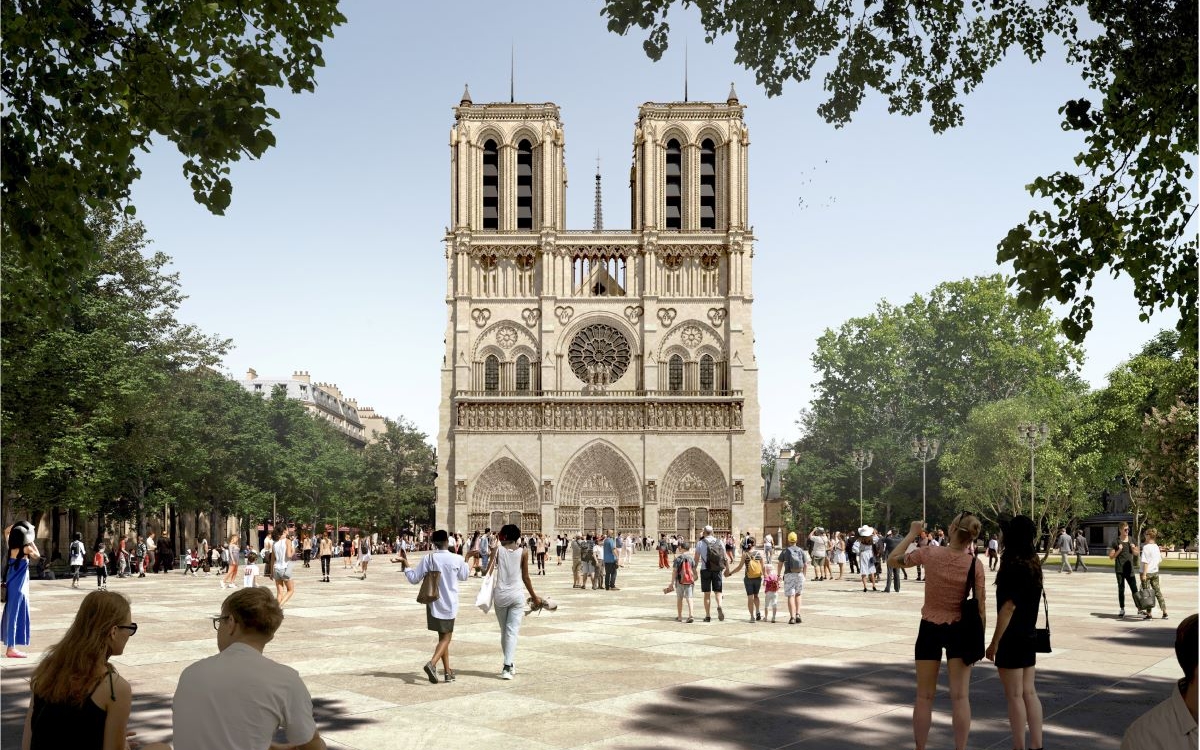
A forecourt designed like a clearing
The new plaza is designed as a clearing that showcases the eastern facade of Notre-Dame within a green setting. The surrounding trees will provide shaded seating, while a thin 5-millimeter-high stream of water will flow intermittently to cool the plaza during periods of extreme heat, creating fleeting reflections.
At the tip, a green, peaceful, and unspoiled area
The area behind the cathedral, which is as large as the forecourt in front, will become a square stretching from the apse to the tip of the Île de la Cité. It opens onto the flying buttresses and stained-glass windows and showcases the Memorial to the Martyrs of Deportation.
Another new feature: traffic on Rue du Cloître-Notre-Dame and the Archevêché Bridge will be calmed and green spaces will be added.
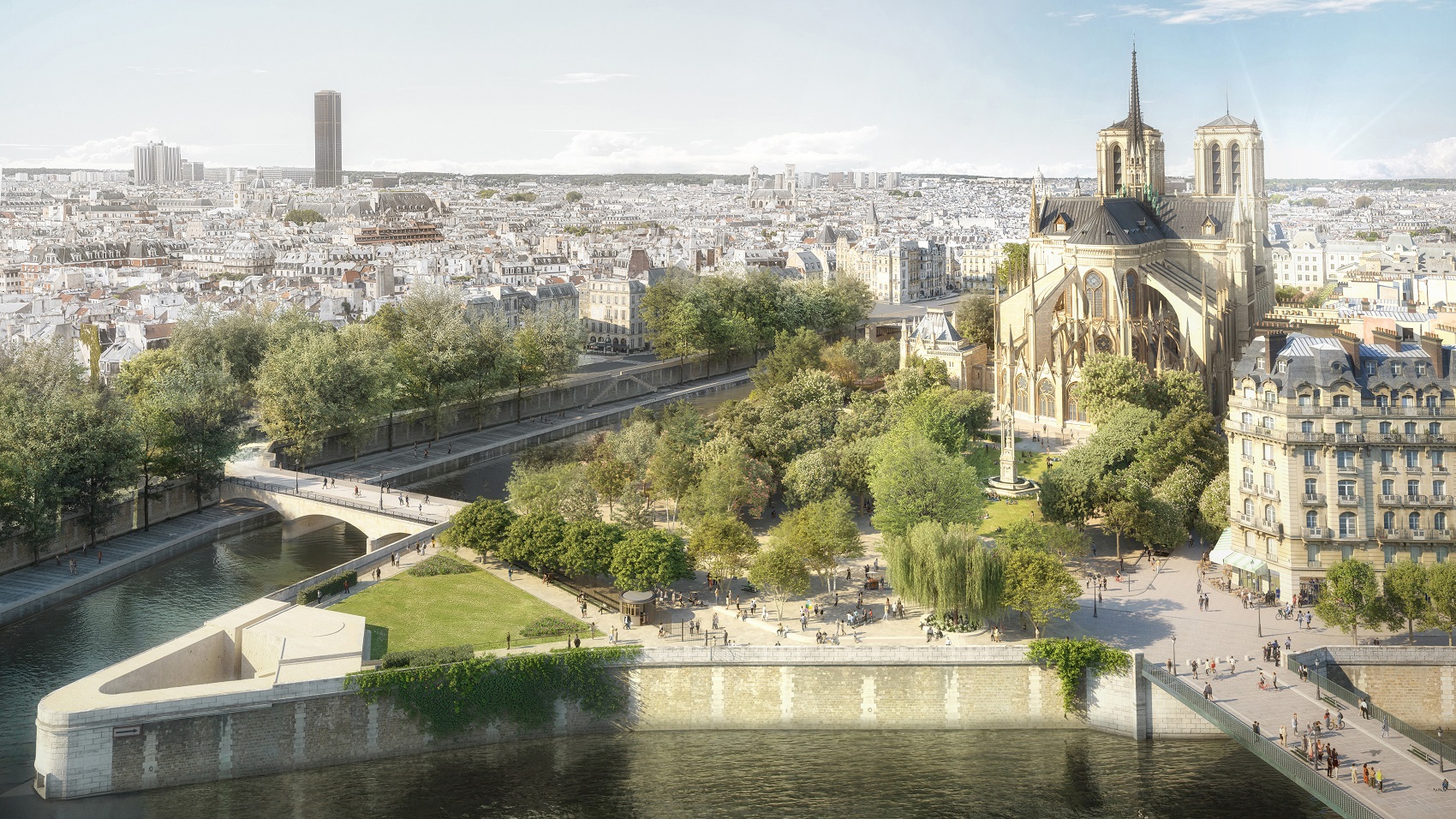
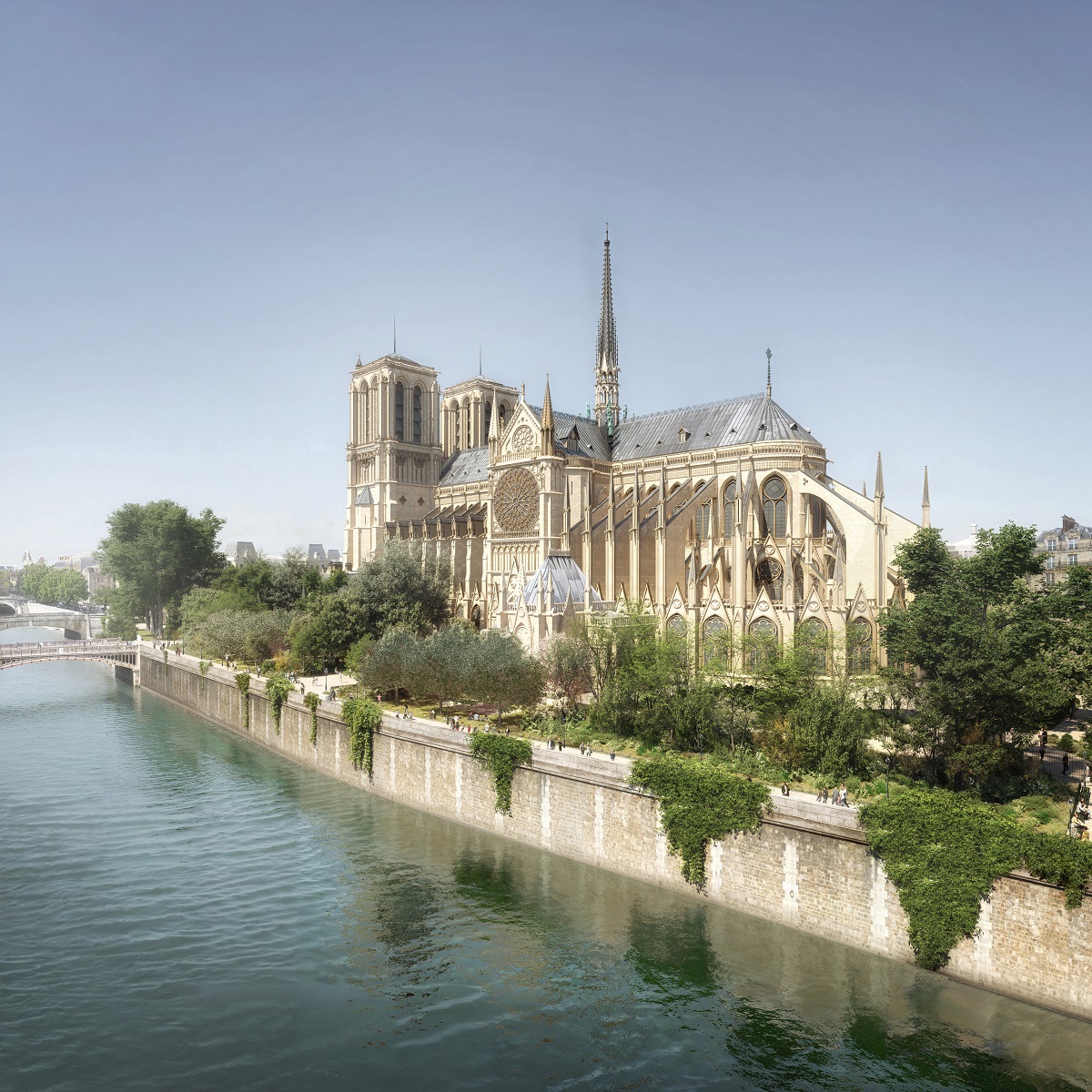
The gardens south of the cathedral, along with the existing trees, will be incorporated into a large riverside park 400 meters long. A total of 180 new trees will be planted, and the 180 existing trees will be preserved.
The Notre-Dame site will see an increase in green space, with an additional 1,800m² of greenery (+10%).
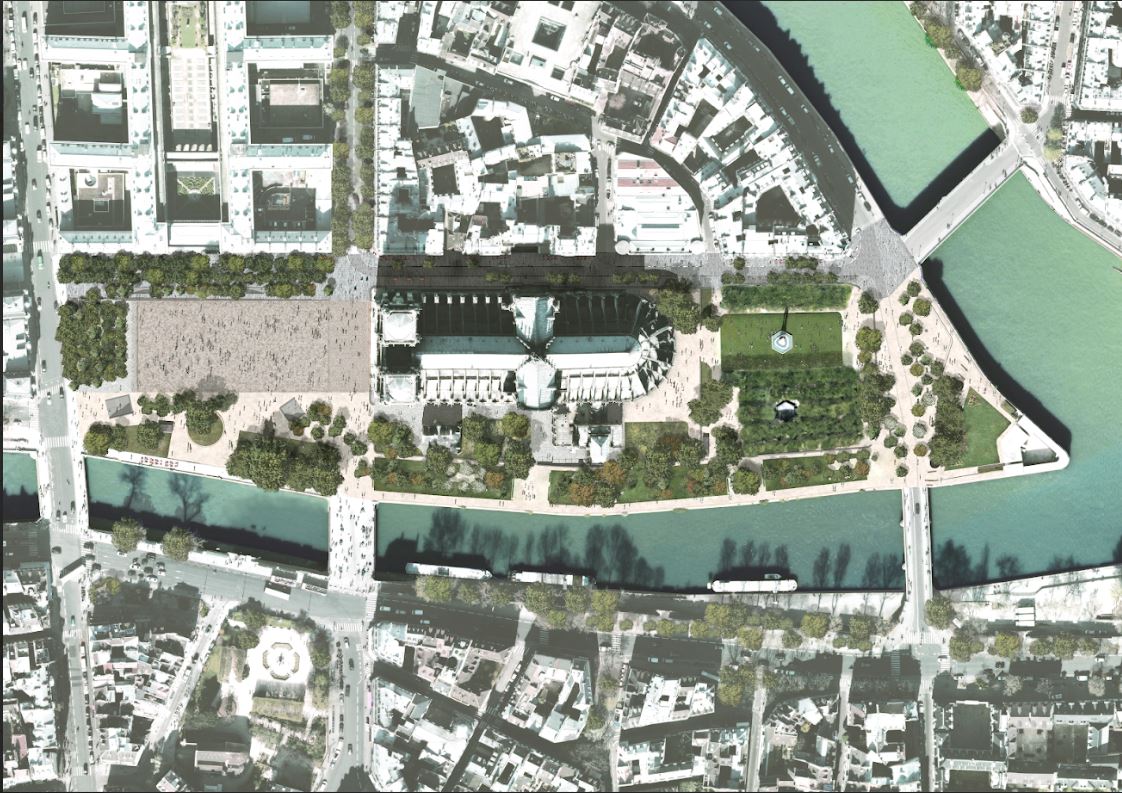
4.7 hectares redeveloped
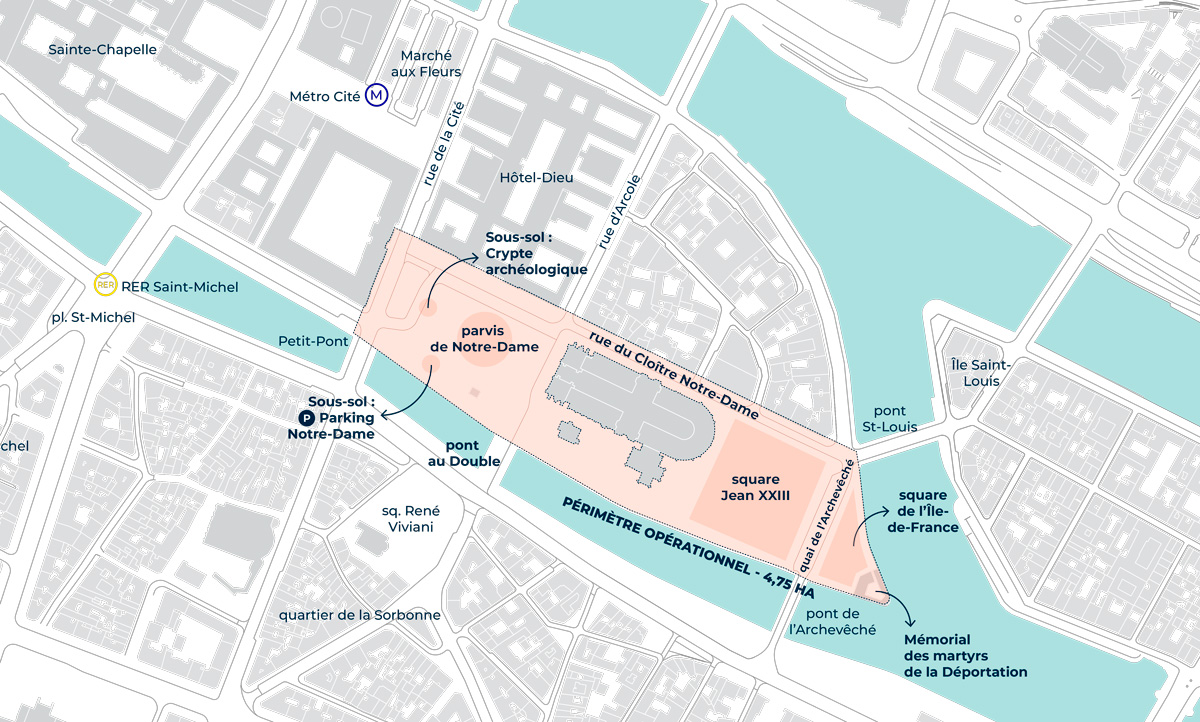
Carried out in close collaboration with the Public Conservation and Restoration Agency of Notre-Dame de Paris Cathedral (EPRND)—which made it possible to reopen the cathedral to the public in December 2024—the Notre-Dame surroundings project concerns not only the forecourt but also the surrounding area. It is part of the plan to revitalize downtown Paris through pedestrian-friendly measures and improvements carried out as part of the “Embellir votre quartier” initiative.
Specifically, the redevelopment will involve:
- the forecourt
- Jean XXIII Square and Île-de-France Square (located behind the cathedral) all the way to the tip of Île de la Cité
- the banks of the Seine, upper and lower
- the adjacent streets (Rue du Cloître-Notre-Dame, Rue de la Cité, Quai de l'Archevêché)
The project is designed to respect the buildings and landscapes of high heritage value that surround the site, particularly the “Paris, Banks of the Seine” site , which has been listed as a UNESCO World Heritage Site since 1991.
Notre-Dame is the centerpiece of this exceptional site. Its urban setting is characterized by the large-scale public buildings of the Haussmann era, lending it a monumental scale. Aside from the cathedral and the Conciergerie, only Place Dauphine and the heart of the block between Rue d’Arcole and Rue du Cloître Notre-Dame survived the massive demolitions ofthe 19th century. Thus, the Notre-Dame site is not a homogeneous space and has already undergone numerous transformations.
Redevelopment of the eastern tip of the Île de la Cité
The redevelopment of the eastern tip of the Île de la Cité is also part of the project to revitalize the area surrounding Notre-Dame.
The three objectives of the project
Adapting the site to climate change
The project transforms a heavily built-up area by significantly increasing its green space. It calls for the removal of impervious surfaces over an area of more than 1,000 m², the planting of 165 additional trees around the cathedral, and the creation of a continuous landscape connecting the cathedral plaza, Jean XXIII Square, the tip of the island, and Île-de-France Square.
This return to nature will improve stormwater infiltration, help combat heat islands, and promote biodiversity. The selection of plants was determined based on environmental and botanical studies conducted in advance, focusing on species that are resilient to climate change and consistent with the site’s landscape history.
Strengthening the Promotion of Notre-Dame’s Heritage
The project also addresses a major heritage objective: to restore the cathedral’s landscape and urban setting to a level befitting its significance, by redeveloping the squares, streets, and forecourt areas, restoring the monumental views, and enhancing the site’s openness toward the Seine.
Improve visitor amenities in an area that attracts large numbers of tourists.
The challenge: to better integrate the monument into its immediate surroundings while improving visitor amenities and circulation.
What's the schedule?
Work will begin on August 31, 2026, with preventive archaeological excavations, and will continue through May–June 2027. The park will be closed to the public starting August 24. The Memorial to the Martyrs of the Deportation will remain accessible for the duration of the project, except for occasional disruptions related to the work. Work will continue on the plaza (estimated start date in the third quarter of 2027) and then on Jean XXIII Square beginning in 2028.
The Next Steps in the Redevelopment
- Summer 2027–late 2028: work on the cathedral’s forecourt and facade.
- 2029–2030: Work on Jean XXIII Square and the Maurice Carême Promenade, following the final clearance of the cathedral construction site, scheduled for late 2028.
Archaeological excavations: the first phase of the project
In the 1970s, excavations conducted on the cathedral’s forecourt uncovered the remains of ancient and medieval residential neighborhoods, which are now on display in the Archaeological Crypt Museum. At the time, these excavations did not cover the entire site.
As part of the development project, the City of Paris’s Archaeological Center conducted preventive excavations designed to identify any remains that might be destroyed by the construction work.
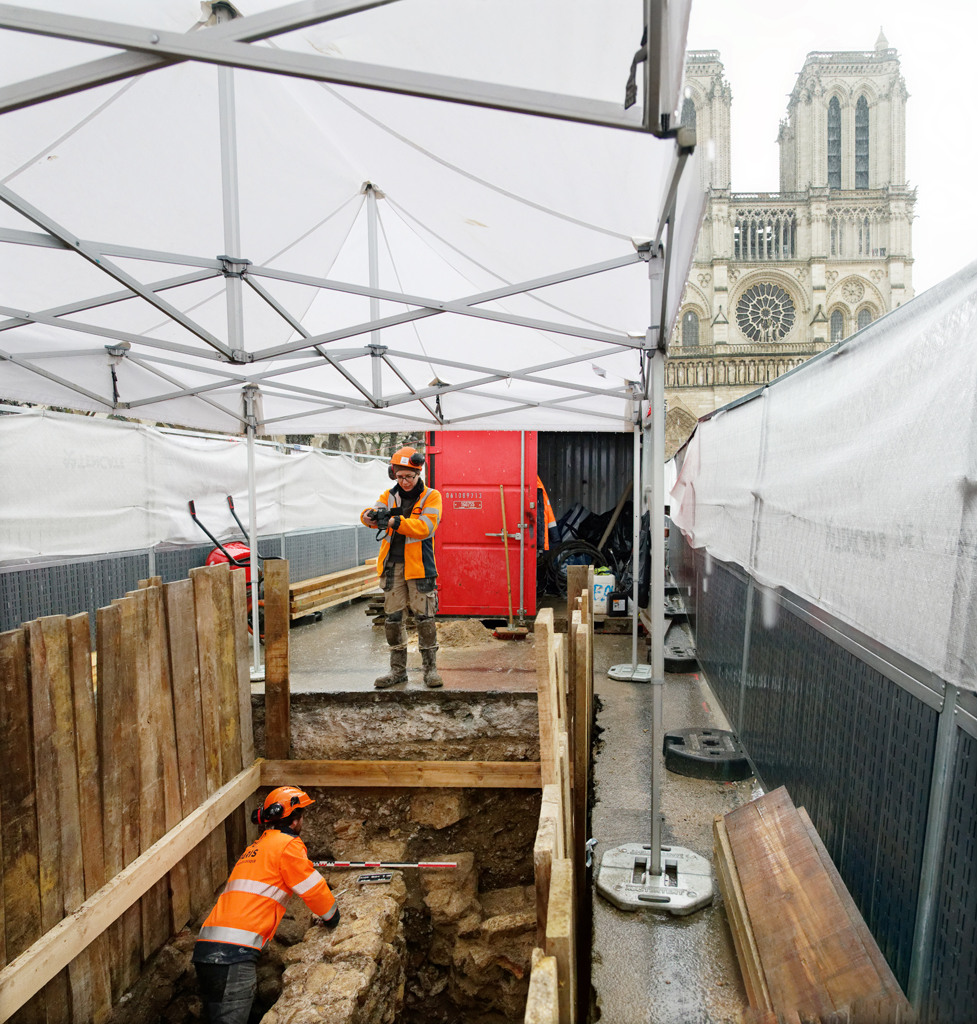
The Archaeological Center is tasked with cataloging, studying, preserving, and promoting this exceptional heritage. It is also authorized to conduct archaeological surveys and excavations within the Paris metropolitan area.
The teams step in:
- prior to the start of construction, through the completion of a scientific study that defines the scope of the excavations;
- on-site, including excavation, which—using a backhoe—allows access to deeper archaeological layers and thus to the remains and artifacts that can be recovered;
- in the laboratory, where the discovered objects are cleaned, sorted, cataloged, and studied.
Each step is documented (notes, drawings, photographs, topographic surveys, etc.) to enable archaeologists and experts to trace the site’s history.
Some of the artifacts discovered during the excavation may enrich the museum exhibition at the Archaeological Crypt of Notre-Dame de Paris.
Good to Know
Following an initial meeting of the National Commission for Heritage and Architecture (CNPA) to discuss the project’s scope, the commission met a second time on May 11, 2024, and issued a favorable opinion on the project led by the Bas Mets team. >Learn more about the CNPA
The Île-de-France Regional and Interdepartmental Directorate for the Environment, Planning, and Transportation (DRIEAT) also issued, on April 28, 2023, a favorable decision on the project to redevelop the area surrounding Notre-Dame, exempting the City of Paris from conducting an environmental assessment. > View the opinion
Public Consultation
A broad public consultation was conducted from May to November 2021 regarding the future of the area surrounding Notre-Dame. The goal: to engage the broadest possible audience in the project (site stakeholders, local residents and business owners, Parisians, residents of Greater Paris and the Île-de-France region, and visitors).
What kind of funding?
This project is being funded by the City of Paris to the tune of 50 million euros.
The area around Notre-Dame is brought to life through podcasts
A series of podcasts, each under five minutes long, features perspectives from experts, researchers, educators, and young people who have explored the issues surrounding this exceptional site. What do the “surroundings” of Notre-Dame mean? How has the landscape around the cathedral evolved? How does the Diocese of Paris view these surroundings and their future development?
Settings Text Html